the NR group development professionals     
 

Fisheries Products: Support to Competent Authorities
in Fiji, Papua New Guinea and the Solomon Islands

Donors: Strengthening Fisheries Products (SFP) EC programme, DEVFISH/Forum Fisheries Agency

Third Countries (those outside the EU) face many problems in getting their food products into EU markets and one of the biggest barriers to access is the formidable task of complying with EU legislation on food safety. Thousands of pages of legislation have to be dealt with and, as the legislation is updated regularly, Third Country industry and regulatory authorities face a constant struggle to keep up with the latest changes. The sheer volume of the legislation and its complexity create a real challenge for exporters and for the Competent Authorities which have to certify products as complying with EU legislative requirements. Fisheries products are an important source of export revenue for many countries and especially for island states. Direct export of fishery products offers developing countries the opportunity to obtain greater value from their fishery resources as compared to indirect exports through fishery access agreements. As well as giving higher export revenue, the onshore processing of fishery products creates many jobs, often in locations where alternative employment is very limited.

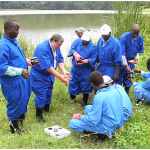
Ian Watson has been working with the Competent Authorities in Fiji, Papua New Guinea and the Solomon Islands to help them to improve and strengthen their regulatory frameworks and inspection systems to meet the increasingly strict requirements of the EU. The work has been a combination of mentoring, consultancy and training for the Competent Authorities mostly delivered “on the job” at the premises of fishery products exporters. Consultancy and mentoring has also been given to the processors on improving their production processes and particularly their food safety systems.

Ian Watson has also carried out assessment visits to the Cook Islands, Kiribati, Niue, Samoa, Tonga and Tuvalu to assess the ability of industry and the Competent Authority to access EU markets and to comply with the food safety legislation. Proposals were made to SFP on projects to support these countries in their efforts to expand their exports by accessing EU markets.

Processing fresh fish for export Packing fresh fish for export
Processing fresh fish for export. High levels of cleanliness are essential
Packing fresh fish for export. Considerable care in taken to ensure the product arrives in best condition
Offloading frozen tuna Trainees practicing the use of contact plates
Offloading frozen tuna from a carrier vessel. EU food safety regulations apply even at sea

Trainees practicing the use of contact plates
for checking cleaning and sanitation procedures

Cooked tuna loins are prepared for canning the entire canning line must be cleaned
Canned fish is a major export market for some developing countries. Cooked tuna loins are prepared for canning
After every shift, the entire canning line must be cleaned. Factories must meet high standards of cleanliness if they are to pass EU inspections
trainee learns how to take swab samples Trainees checking plate counts
A trainee learns how to take swab samples to check the effectiveness of cleaning and sanitation procedures
Trainees checking plate counts from the swab samples
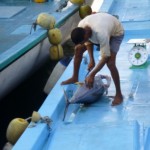
Unloading fresh tuna from a long-liner
Unloading fresh tuna from a long-liner.
These can supply top quality fish to EU markets


Page last updated February 5, 2009